
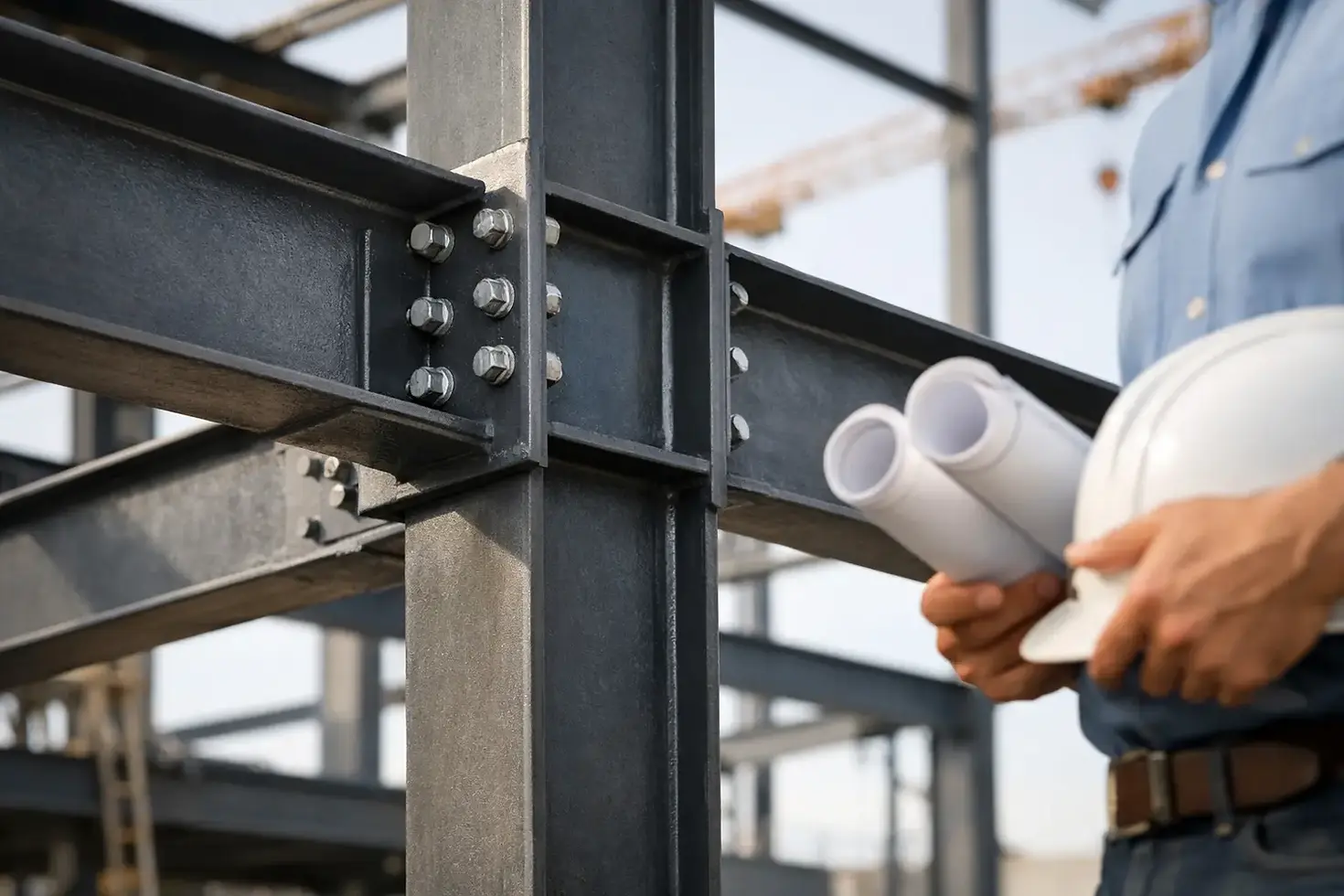
Structural Steel Connection Design Explained
- Ahmad Samadi
- Jun 22
- 6 min read

On a steel project, the frame rarely fails at the member. More often, project risk gathers at the connection - where forces transfer, tolerances accumulate, fabrication decisions tighten, and site constraints become real. That is why structural steel connection design deserves early, disciplined attention. It is not a drafting exercise added at the end. It is a core part of structural performance, constructability and compliance.
For developers, builders, government clients and delivery teams, connection design affects more than engineering calculations. It influences fabrication lead times, erection sequencing, inspection requirements, coating systems, fire protection interfaces and long-term maintenance. On complex buildings and infrastructure assets, poorly resolved connections can trigger redesign, procurement delay and unnecessary site variation.
Why structural steel connection design matters early
A connection must do several jobs at once. It must transfer the required actions safely, satisfy the nominated design intent, suit the fabrication method, tolerate erection realities and align with relevant Australian Standards and project specifications. Those demands do not always point in the same direction.
A simple example is the choice between a bolted site connection and a welded site connection. Bolting may reduce site risk and improve installation speed, but it can increase plate thickness, bolt group size or access requirements. Welding may reduce some connection geometry, but it introduces greater site controls, inspection demands and weather sensitivity. The best outcome depends on the project, not on habit.
This is especially relevant in Sydney and across broader Australian markets where programmes are compressed, trades are layered and urban sites are constrained. When connection strategy is left too late, the project often inherits avoidable friction between design intent and construction method.
The core design questions behind steel connections
At a technical level, structural steel connection design starts with load path clarity. The engineer needs to define what the connection is expected to transfer - shear, moment, axial force, tension, compression, torsion, or a combination. From there, the connection behaviour must be consistent with the global analysis model and the intended frame action.
That sounds straightforward, but the detail is where certainty is won or lost. A connection assumed to act as nominally pinned in the analysis may still attract restraint in practice. A detail intended to be rigid may not achieve the required stiffness if plate flexibility, bolt slip, local deformation or erection tolerance is overlooked. In other words, connection classification is not merely a label. It has to reflect real behaviour.
The engineer must also consider how force transfers through each component, including bolts, welds, end plates, cleats, angles, backing elements and the connected members themselves. Capacity checks are only part of the task. Local bearing, block shear, tear-out, prying action, weld access, lamellar tearing risk and member web or flange stability can all become governing issues.
Structural steel connection design and constructability
Constructability is often where good engineering distinguishes itself from nominal compliance. A connection can satisfy design actions on paper and still create delivery problems if it cannot be fabricated efficiently or erected safely.
Access is a common issue. Bolt installation requires sufficient tool clearance. Welds require appropriate preparation, sequencing and inspection access. Stiffener arrangements may interfere with adjacent trades or make galvanising and coating application more difficult. In architecturally exposed steelwork, the tolerance for visual irregularity is lower, which further tightens the detailing standard.
Connection design also affects erection methodology. Temporary stability during lifting and sequencing must be considered, particularly in long-span structures, transfer elements, trusses, plant platforms and bridge works. The final connection may be adequate in the completed structure, but the partially erected state can govern the temporary works approach.
For this reason, disciplined projects coordinate the structural engineer, steel detailer, fabricator and erection team early. That coordination does not dilute design responsibility. It improves the reliability of the design outcome.
Compliance, standards and project assurance
In Australia, connection design must sit within a clear compliance framework. That includes the relevant National Construction Code requirements, applicable Australian Standards, project technical specifications, authority conditions and, where relevant, transport or government asset standards. For public and infrastructure projects, documentation quality and traceability are particularly important.
Connection documentation needs to be unambiguous about design assumptions, loads, materials, weld categories, bolt classes, corrosion protection and inspection requirements. Where delegated design is used, the boundaries of responsibility should be clearly defined. Ambiguity at this interface is a common source of commercial dispute and programme disruption.
For procurement teams and asset owners, assurance is not just about whether the detail can be built. It is about whether the design basis is transparent, reviewable and aligned with the project risk profile. A hospital, public building, bridge or water asset may require a different level of review, redundancy or durability consideration than a low-complexity industrial structure.
Typical connection types and where judgement matters
Most steel projects use a combination of shear connections, moment connections, bracing connections, base plates and splices. The engineering challenge is not choosing from a standard menu. It is selecting and refining the right detail for the specific structural system and delivery environment.
Simple shear connections can appear routine, yet they often become congested when multiple members frame into a single support or when fire protection, façade brackets and services all compete for the same zone. Moment connections require careful assessment of stiffness, ductility and fabrication demands. Bracing connections can attract significant force concentration and are often sensitive to gusset geometry and out-of-plane effects.
Base plate design brings another layer of complexity because the steel connection is only one side of the interface. Anchor design, grout behaviour, concrete edge distances, holding-down tolerances and foundation reinforcement all affect performance. The best base detail is usually the one that resolves both the steel and concrete realities together.
Splices also deserve close attention. They are frequently introduced for transport, lifting or fabrication reasons rather than pure structural preference. Once that happens, the splice becomes part of the project logistics strategy as much as the structural scheme.
Where connection design commonly goes wrong
The most frequent issues are not exotic failures. They are coordination failures. Loads are issued without clear design intent. Architectural geometry changes after the steel concept is set. Service penetrations reduce available connection space. Fire and corrosion systems are nominated after details are advanced. Tolerances are underestimated until site installation exposes the problem.
Another recurring issue is overdesign without delivery logic. Very heavy plates, dense welds or oversized bolt groups may appear conservative, but they can increase cost, distortion risk, handling difficulty and fabrication time. Efficiency in connection design is not about making details light at all costs. It is about matching capacity, stiffness, durability and buildability with discipline.
Delegated connection design can also create gaps if the primary design model, connection assumptions and temporary condition requirements are not properly communicated. Where multiple parties contribute to the final detail, governance matters. Clear review pathways, hold points and authentication processes reduce the risk of late-stage surprises.
A better project approach
The most reliable projects treat structural steel connection design as an integrated engineering task, not an isolated shop-detailing package. Early in design, the structural strategy should identify the likely connection hierarchy, critical force-transfer zones, erection constraints and any areas where non-standard detailing is expected. During design development, these assumptions should be tested against fabrication and construction methodology.
For complex projects, advanced analysis and modelling can add significant value. Connection stiffness assumptions may need to be reconciled with the global frame model. Fatigue, dynamic behaviour, thermal movement, progressive collapse considerations or high-consequence loading scenarios may justify a more detailed assessment. This is where a research-led and compliance-focused engineering process improves project certainty.
A multi-disciplinary perspective is also important. Façade loads, fire protection build-ups, civil interfaces, geotechnical movements and construction staging can all change connection demands. On integrated projects, better outcomes come from coordinated engineering rather than sequential problem-solving.
At EBNI, this is approached as part of broader project assurance - combining structural analysis, constructability review, compliance discipline and transparent technical documentation to support dependable delivery outcomes.
What clients should ask before sign-off
Before steel packages are finalised, clients and project managers should be confident on several points: whether connection behaviour aligns with the design model, whether delegated responsibilities are defined, whether erection methodology has been considered, and whether inspection and durability requirements are documented clearly. If those questions are unresolved, the programme risk usually remains hidden rather than removed.
Connection design is rarely the most visible part of a project, but it is often one of the most consequential. When it is handled with precision, the structure is easier to fabricate, safer to erect, clearer to certify and more reliable in service. That is the practical value of disciplined engineering - decisions made at the connection level that protect performance across the life of the asset.


Comments